India in the Americas: How Growing Investment Could Rebalance Latin America's Strategic Landscape

This article was published in collaboration with the Young Diplomats Society, as part of their Year in Review.
Since Narendra Modi’s election in 2014, a flurry of state visits between the sub-continent and Latin America have marked a shift in Indian foreign policy, and has spurred a sense of interest in relations across the Pacific. China is a dominant force in the region - however Indian investment, with Australia as a collaborator, has the potential to recalibrate the regional balance of powers.
Trade links between Asia and Latin America date back hundreds of years, and can be seen symbolically in cuisine; bananas and mangoes were introduced to Latin America from India via trade routes.
In 2023, Indian investment has reached approximately $40 billion, with trade between the two regions increasing by 145% - mainly consisting of value-added products such as automobiles, agrochemicals, auto-parts, pharmaceuticals, textiles and refined petroleum. However, Latin American trade with China is twelve times greater, at a sum of $480 billion. The Belt and Road Initiative has twenty two Latin American partner countries, and the China Development Bank and the Export-Import Bank of China contribute a significant infrastructure and lending partner.
The economies of the two regions are complementary; India-Latin America trade is largely an exchange of primary commodities and secondary commodities. The majority of this exchange is with Brazil; by value, and by number of companies- receiving about 70%, or US$6 billion of Indian foreign direct investment. Reciprocally, Brazil mainly exports raw commodities like crude oil, cotton, sugar and soybean oil. They share warm relations; apart from their collaboration as BRICS members, Modi was warmly welcomed by Brazilian President Lula da Silva on a state visit earlier this year. Brazil has also not formally joined the Belt and Road Initiatives, and are perhaps keen to also diversify their economy.
Brazilian state-owned Petrobras and Indian Bharat Petroleum Corporation have signed an agreement for the delivery of six million barrels of oil annually between 2025 and 2026. This agreement will boost Brazilian oil exports, but also Indian imports - of which the country has a dependence on to fill the demand of its rapidly growing middle-class. The remainder of the investments are distributed among Argentina, Uruguay, and Mexico.
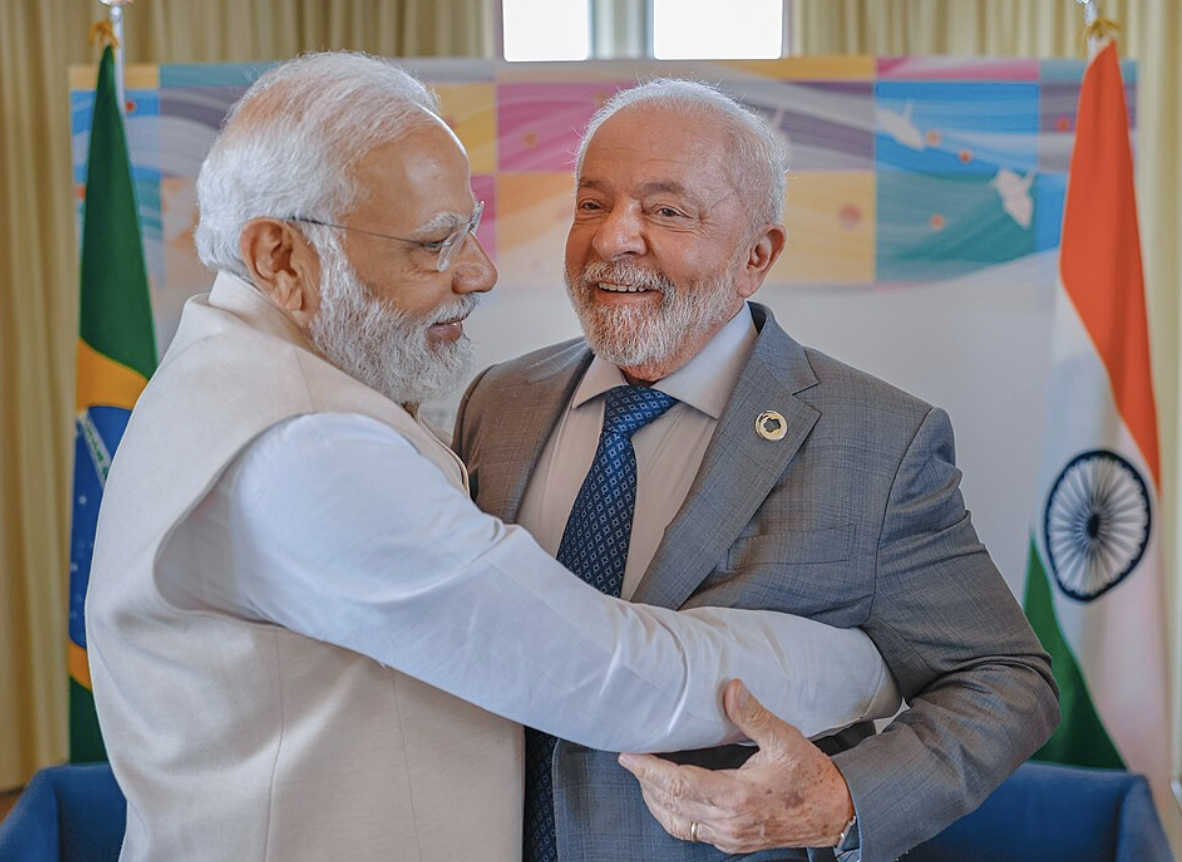
Prime Minister Narendra Modi and President Luis Inácio de la Silva
Prime Minister Narendra Modi and President Luis Inácio de la Silva embrace at the 2023 G7 Meeting in Hiroshima, Japan. Image Credit: Ricardo Stuckert/PR via Wikicommons
But India is looking to expand these trade links, partly through material necessity of a rapidly developing, greatly populated country, but also out of ideology. India’s foreign policy outlook has traditionally been seen as ‘non-alignment’, an era of Cold War politics. It has now evolved into ‘strategic autonomy’, best understood as taking advantage of as many different partnerships as possible without committing to alliances. Externally, for countries wishing to diversify their economic partners, India is seen as an independent, democratic, and largely neutral option as geopolitical tensions rise between the large powers.
Specifically, India has its eyes on critical minerals, needed for renewables and green technology. A trade agreement has just been signed with Peru, and is almost complete with Chile. India has also just opened an embassy in lithium-rich Bolivia, which has the world’s largest reserves - which now may be an opening to the global market by the newly elected, centre-right President Rodrigo Paz. Chile also offers access to other critical minerals such as copper, and crucially, port access connecting Asia and the South American continent across the Pacific Ocean. China understands the importance of this access, building a port in Chancay, north of Lima in Peru, which will cut shipping to Shanghai by a week.
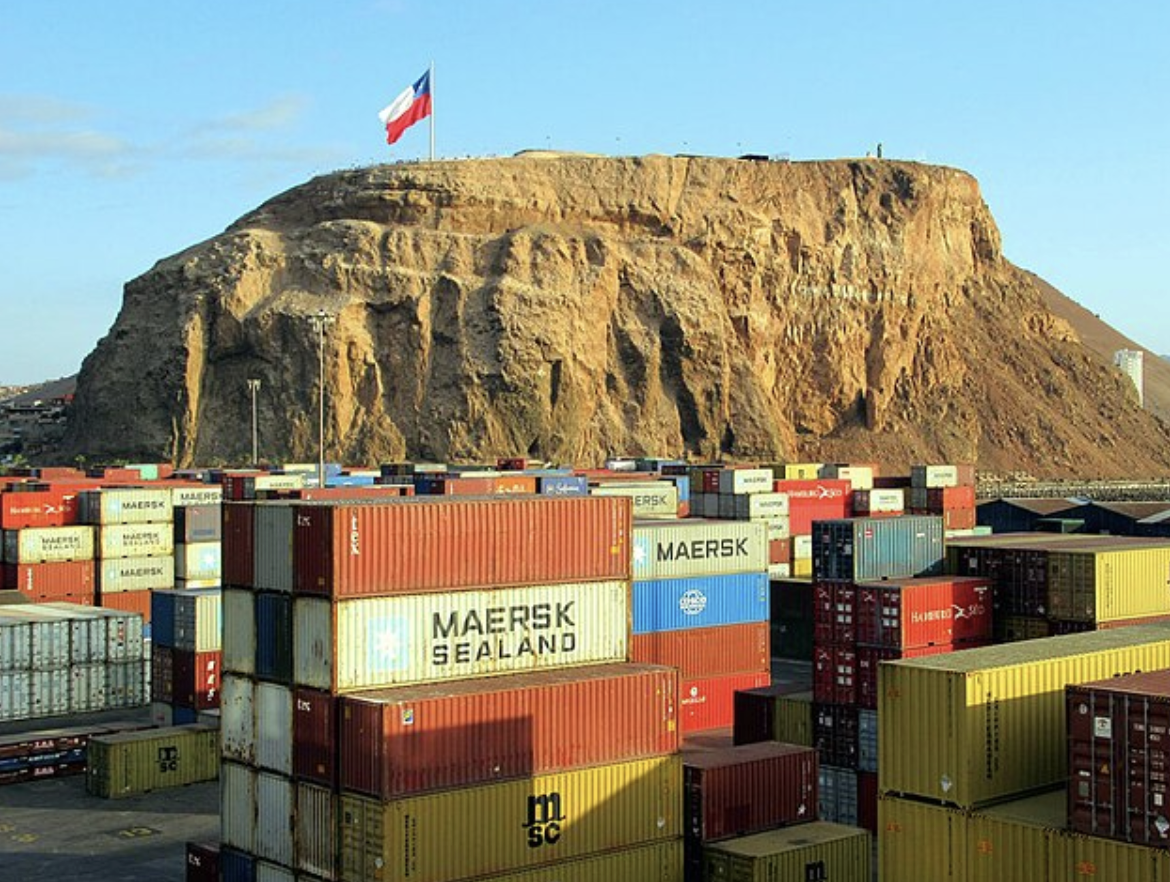

The Port of Arica, Chile.
Much of landlocked Bolivia’s trade passes through this port in the north of Chile. Image Credit: David Stanley via Wikicommons
.jpg)
The same strategic opportunity exists for Australia and India. An Australian-backed port on the Eastern side of the Pacific would provide a badly needed direct shipping route; India-Australia-South America.
The major impediment for trade between Australia and India, with Latin America, is geographic distance. The current shipping route between Australia and South America stops in Panama - a direct route could cut down shipping time by about ten days. It would also provide a link to India for the shipping of Bolivian, Peruvian and Chilean critical minerals, and crude exports from Brazil. The Port of Darwin could also be used as a refuelling stop between the two regions, stimulating domestic economic growth. Extended further, a series of Australian-backed strategic bridges or tunnels connecting trade to the Pacific can further counter Chinese influence, and connect the continents.
Beyond economics, it is in Australia’s interest to counter Chinese influence in Latin America, just as it is attempting to do in the Asia-Pacific region. Between the threats of tariffs, the unpredictability and internal turmoil of the United States, the significant cuts made to USAID, the decline of the United States will leave a vacuum in external influence on the region. Australia can capitalise on its positive international reputation to step up and become an option for Latin American governments needing funding for development.
Latin American and Indian economies are complementary, and with Australia’s influence, ties between the regions can become much closer. India and Australia can leverage their status as middle powers to create new supply chains and to counter Chinese economic and political influence. Latin America can take advantage of India’s appetite for raw materials, and Australia’s potential as a developed export market. This is an opportune time for governments from all sides to leverage geopolitical unrest, and can be a window of opportunity for Latin America to be brought closer to India and Australia’s orbit.
Content Disclaimer
The views expressed in this article are those of the author and do not necessarily represent the views or opinions of the Australia Latam Emerging Leaders Dialogue.
Collage image credit all via wikicommons

_(14759599246).jpg)
Prime Minister’s Office https://commons.wikimedia.org/wiki/File:Prime_Minister_Of_Bharat_Shri_Narendra_Damodardas_Modi_with_Prime_Minister_Of_Australia_Mr._Anthony_Albanese.jpg

Unkown Japanese Cartographer https://commons.wikimedia.org/wiki/File:1853_Kaei_6_Japanese_Map_of_the_World_-_Geographicus_-_ChikyuBankokuHozu-nakajima-1853.jpg

Tvabutzku1234 https://commons.wikimedia.org/wiki/File:Ship_Cosco_Shipping_Leo_(2).jpg
.jpg)
Post of Brazil https://commons.wikimedia.org/wiki/File:Stamp_of_Brazil_-_1968_-_Colnect_263133_-_Petrobras_Refinery.jpeg

Mike Peel https://commons.wikimedia.org/wiki/File:At_Tenerife_2022_227.jpg

Ivar Leidus https://commons.wikimedia.org/wiki/File:Mangos_-_single_and_halved.jpg

Coordenação-Geral de Observação da Terra/INPE https://commons.wikimedia.org/wiki/File:Salar_de_Atacama,_Chile.jpg
