
Photo by Pixabay from Pexels
Most people imagine the internet as something immaterial: clouds, wireless signals, invisible streams of information moving instantaneously across the world. Yet the digital economy depends on a physical infrastructure that remains largely unseen. Thousands of kilometres of submarine fibre optic cables lie across the ocean floor, carrying financial transactions, government communications, social media interactions, military data, and everyday conversations. These cables rarely enter public discussion, despite underpinning contemporary globalisation.
Their importance has become increasingly difficult to ignore. In recent years, governments, multinational corporations, and strategic analysts have turned their attention toward these infrastructures with growing urgency. Control over digital routes now carries geopolitical significance comparable to ports, trade corridors, or energy pipelines. Questions of connectivity are no longer merely technical matters; they are tied to sovereignty, security, economic influence, and diplomatic positioning.
Latin America occupies an interesting place within this transformation. Historically, the region has often been treated as peripheral in discussions surrounding technological innovation and digital governance. Much of its communication infrastructure has depended on systems designed elsewhere, particularly in the United States and Europe. That perception is beginning to shift. Latin America’s location between the Atlantic and Pacific oceans gives it strategic relevance in a world increasingly organised around data circulation and transoceanic connectivity. Countries such as Chile, Brazil, Mexico, and Colombia are becoming important nodes within emerging digital corridors linking the Americas, Asia-Pacific, and Europe.
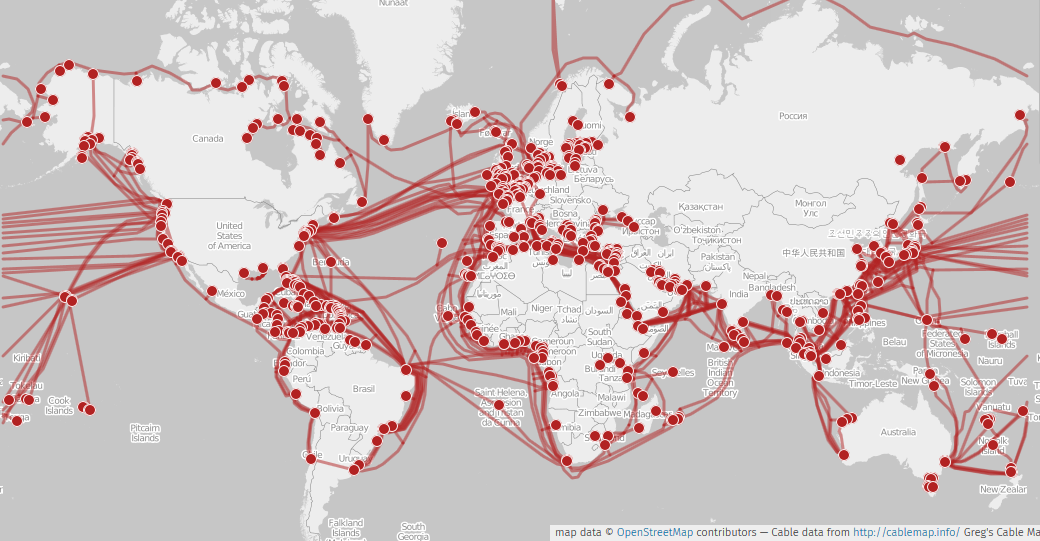
World map of submarine communication cables by Greg Mahlknecht is licensed under Creative Commons Attribution-ShareAlike 2.0 Generic
To understand why this technology matters beyond everyday internet use, Actor-Network Theory offers a useful lens for examining these developments because it moves away from the idea that politics is shaped exclusively by states or institutions. Bruno Latour (2005) argues that networks are composed not only of people but also of objects, technologies, infrastructures, and material systems that shape social life. From this perspective, submarine cables are not passive instruments operating in the background of global affairs. They actively organise relations between governments, corporations, financial markets, security agencies, engineers, and users.
Therefore, the cable itself becomes political. Its route determines which countries gain strategic importance and which remain dependent on external infrastructures. Landing stations influence patterns of investment and development. Decisions about ownership affect questions of surveillance, cybersecurity, and technological autonomy. Even the seabed acquires geopolitical relevance once it becomes a corridor for data transmission.
Seen through this framework, digital infrastructure is no longer a neutral backdrop but part of a wider network of power. Technology and politics become inseparable. This is where technopolitics also enters the discussion. Technopolitics refers to the ways technological systems are used to advance political projects, shape governance, and influence social organisation (Hecht, 2009). Infrastructure also reflects political choices, including particular visions of economic order, security, and international influence.
Current tensions surrounding submarine cables reveal this clearly. Competition between China and the United States is increasingly extending into digital infrastructure projects across the Global South. Chinese firms have invested heavily in telecommunications networks, data systems, and cable construction throughout Latin America, Africa, and Southeast Asia. Western governments, meanwhile, frame many of these projects through the language of strategic risk and cybersecurity. Concerns regarding surveillance, technological dependency, and control over critical infrastructure have intensified diplomatic competition around connectivity itself.
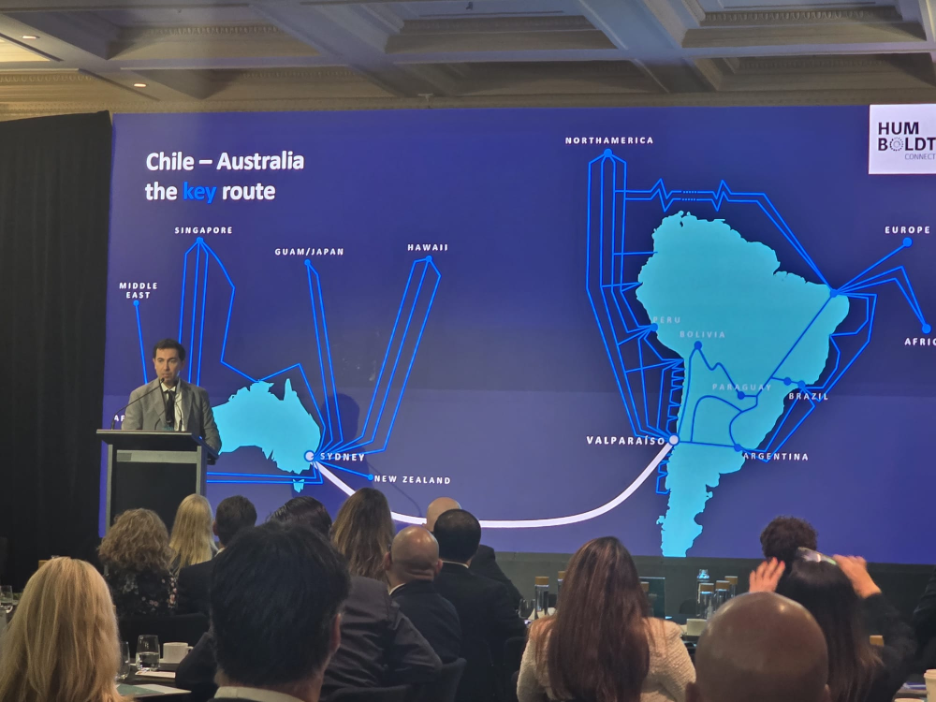
Andrés Contreras speaking at the “Latitudes of Opportunity: Australia – Latin America Forum 2026” at Melbourne Town Hall. Photo by Danis Cruz.
In this context, Latin America has become one of the spaces where these rivalries unfold. The proposed Humboldt Cable connecting Chile with the Asia-Pacific region illustrates how infrastructure projects carry broader geopolitical implications. Beyond improving internet speed or commercial efficiency, the project reflects an attempt to diversify Latin America’s digital routes and reduce dependence on North American intermediaries. The Pacific Ocean, once imagined primarily through maritime trade, is increasingly understood as a digital space structured through data circulation.
Australia enters this conversation in ways that are not always immediately visible. Traditionally positioned within Anglo-American strategic frameworks, Australia has also spent the past decade expanding its engagement with Latin America through diplomacy, education, mining investment, renewable energy partnerships, and regional dialogue. Its broader Indo-Pacific outlook places connectivity and infrastructure at the centre of foreign policy discussions.
What links Australia and Latin America is not simply geography, but a shared position within the broader transformation of the Pacific region. Both navigate relationships with major powers while attempting to maintain economic flexibility and political autonomy. Both are affected by debates surrounding cybersecurity, technological sovereignty, and dependence on external digital systems. Both also occupy strategic positions within transoceanic routes that are becoming increasingly valuable.
Power emerges through networks linking governments, corporations, cables, ports, financial systems, algorithms, engineers, and natural environments. Oceans are not simply empty spaces between territories; they are active infrastructure connecting political and economic systems across continents. Actor-Network Theory helps explain these interconnections by illuminating that geopolitics is shaped by more than nation-states alone.
At the same time, the expansion of digital infrastructure raises difficult questions about inequality and exclusion. Greater connectivity does not automatically translate into democratic access or social inclusion. Significant parts of Latin America continue to experience uneven internet access, particularly rural and Indigenous communities. In some cases, technological development reproduces existing hierarchies rather than dismantling them.
There is also a deeper issue concerning ownership and control. Much of the world’s submarine cable infrastructure is increasingly financed by large technology corporations such as Google, Meta, Amazon, and Microsoft. This marks an important shift from earlier periods when telecommunications systems were largely state-managed. Digital sovereignty becomes more complicated when critical infrastructures operate through hybrid arrangements involving governments, private corporations, and transnational data networks.
Scholars of digital colonialism argue that contemporary technological systems often reproduce older forms of economic dependency (Couldry & Mejias, 2019). Data extraction, platform monopolies, and infrastructural concentration risk consolidating power within a small number of global actors. Connectivity can therefore be both enabling and restrictive. These debates matter because digital infrastructures increasingly shape everyday life. Migration, education, journalism, finance, diplomacy, activism, and cultural exchange all rely on systems that most people never physically encounter. The internet feels immediate and borderless, yet its operation depends upon highly material infrastructures tied to specific political and economic interests.
For emerging leaders across Australia and Latin America, these transformations present important intellectual and political challenges. Discussions about submarine cables are ultimately discussions about power: who controls communication, who benefits from connectivity, and whose interests become embedded within technological systems. They also prompt us to reconsider how regions traditionally viewed as peripheral can shape an evolving geopolitical landscape.
The Pacific is no longer just a maritime or commercial space. It has become a technological territory shaped by fibre optic routes, data flows, cloud infrastructures, and strategic competition. Latin America and Australia are not outside these processes. Both participate in the construction of a new digital geography whose consequences will extend far beyond technology itself.
References
Couldry, N., & Mejias, U. A. (2019). The costs of connection: How data is colonizing human life and appropriating it for capitalism. Stanford University Press.
Hecht, G. (2009). The radiance of France: Nuclear power and national identity after World War II. MIT Press.
Latour, B. (2005). Reassembling the social: An introduction to actor-network-theory. Oxford University Press.
Starosielski, N. (2015). The undersea network. Duke University Press.
BIO: Danis Cruz is a Strategic Communications and Engagement Specialist with experience in the public sector, multicultural and social impact storytelling. Website: daniscruz.weebly.com
Content Disclaimer
The views expressed in this article are those of the author and do not necessarily represent the views or opinions of the Australia Latam Emerging Leaders Dialogue.