European Union: Closing Up to Mercosur and Australia in a Fragmented World

Berlamont Building, home to the European Commission, a key player in the Union’s trade negotiations. Image Credit: Ministry of Foreign Affairs of Ecuador via Wikicommons
Amid increasingly fragmented global commerce, especially after Trump's "Liberation Day" in 2025, Australia and Mercosur –the bloc made up of Argentina, Brazil, Paraguay, and Uruguay– have concluded separate negotiations for trade agreements with the European Union.
The timing matters: after years of negotiations –and in Mercosur's case, decades– these agreements are now moving towards implementation. They form part of the EU's effort to diversify global trade partnerships, strengthen supply chains, and reduce external vulnerabilities. This strategic reorientation also responds to changing global trade dynamics, including a decline in EU exports to the United States, historically its main export destination, amid trade disruptions caused by tariffs imposed by the United States. Moreover, Mercosur is trying to open a new phase for the customs union, with the ratification of the EFTA-Mercosur agreement and ongoing negotiations with partners such as Canada, after years in which internal fragmentation limited progress.
Structurally, the two agreements reflect distinct models of external engagement. While the EU-Mercosur agreement follows a comprehensive association framework –integrating political dialogue, cooperation, and trade, albeit implemented through a fragmented legal structure– the EU-Australia agreement adopts a more streamlined Free Trade Agreement approach, with economic integration largely decoupled from broader political cooperation frameworks. Despite their different structures, both agreements reflect the EU's wider effort to advance similar objectives in its external agenda.
EU-AUSTRALIA
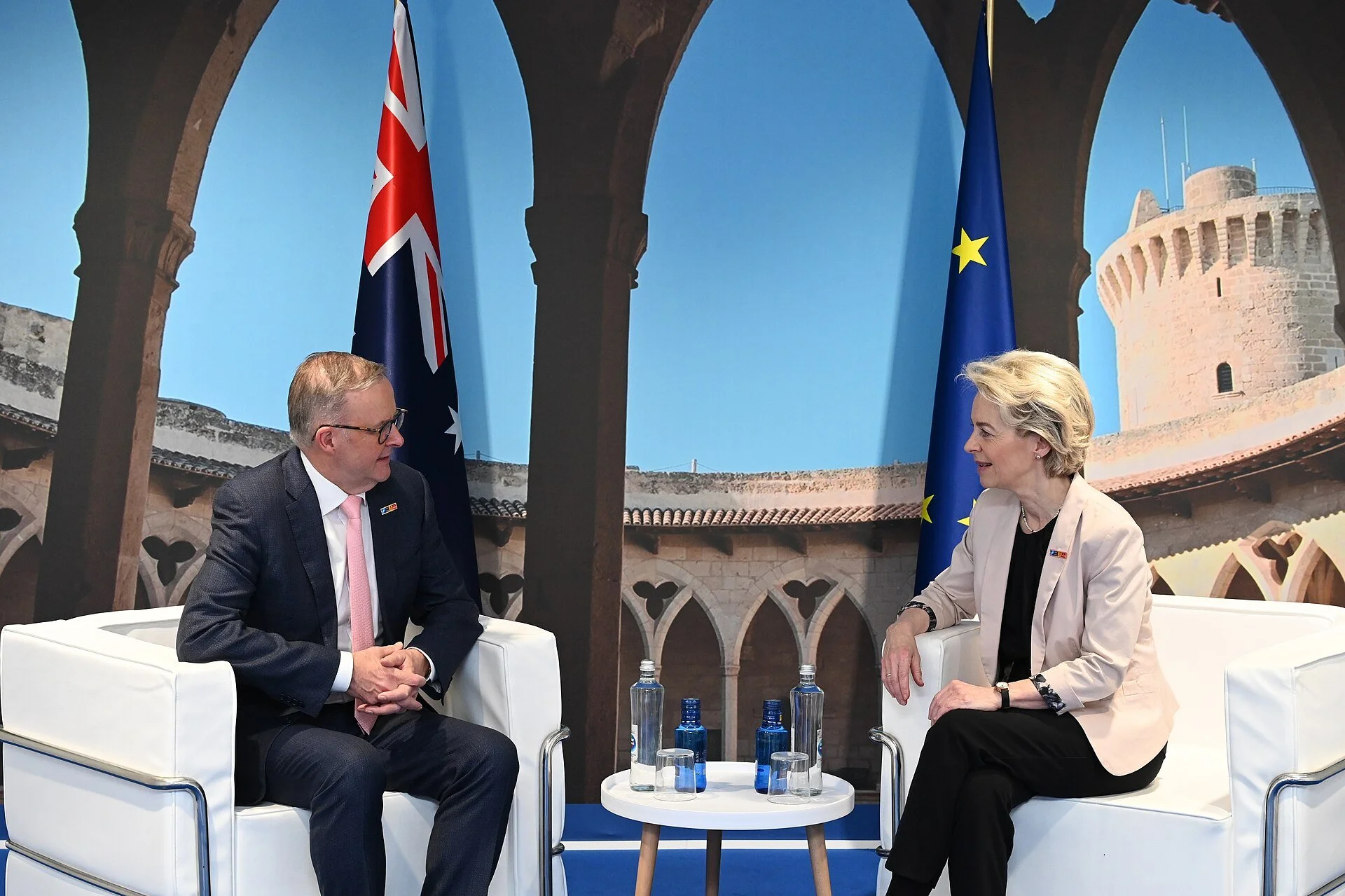
Ursula von der Leyen meets Anthony Albanese at the 2022 NATO summit. Image Credit: Dati Bendo - European Commission via Wikicommons
Last March, Australia and the EU concluded negotiations on a comprehensive Free Trade Agreement, marking a key milestone in their bilateral relations. The FTA will eliminate 98 per cent of tariffs on Australian exports to the EU within seven years, improving access and reducing trade costs for products such as seafood, cereals, sugar, beef, sheep meat, machinery, textiles, and wine, in a market of around 450 million consumers. This is highly significant given that the EU is Australia's third-largest trading partner and its second-largest source of foreign investment.
Beyond tariff liberalisation, the agreement also acts as a geopolitical anchor for Europe in the Indo-Pacific, positioning Australia as a key partner in an increasingly relevant region in world politics. The FTA also includes provisions to enhance access to Australian critical raw materials, aligning with the EU's strategy to diversify supply chains and reduce strategic dependencies.
A distinctive feature of the agreement is its inclusion of provisions addressing the rights and interests of Australia's First Nations peoples. These provisions support trade and investment opportunities in sectors such as art, energy, natural resources, and agri-food systems, and include mechanisms such as resale royalty rights for artists.
Parallel institutional frameworks also support the relationship, including the EU-Australia Framework Agreement and the EU-Australia Security and Defence Partnership, which cover security and defence, research and innovation, education, digital governance, climate action, and environmental protection. This reflects a model in which economic and political cooperation are institutionally distinct but strategically aligned.
EU-MERCOSUR
.jpg)
.jpg)
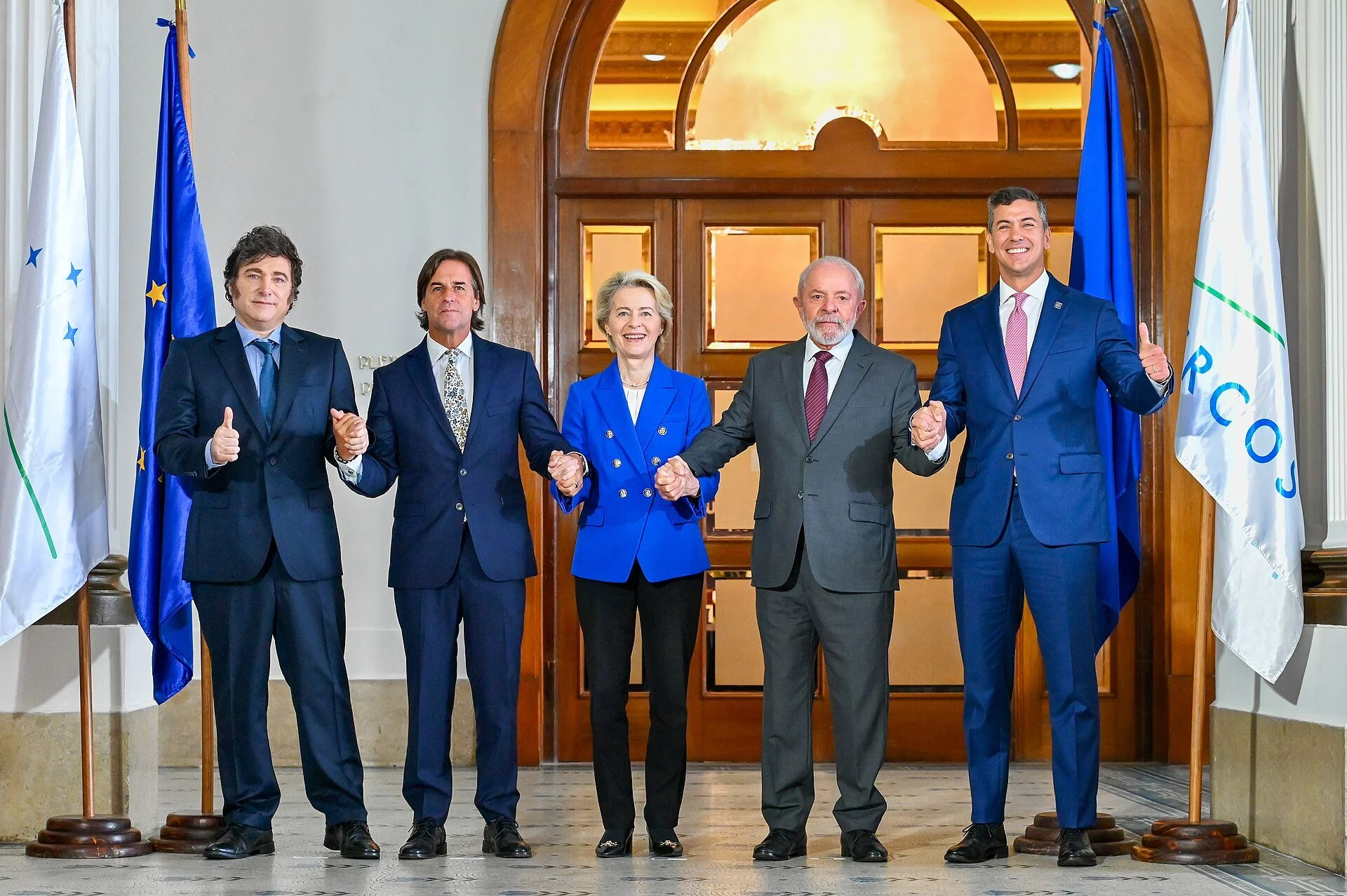
President of the European Commission, Ursula von der Leyen, and Presidents of Mercosur member countries in Montevideo, Uruguay. December 5, 2024. Image Credit: Dati Bendo - European Commission via Wikicommons

After more than two decades of negotiations, the EU and Mercosur reached a political agreement in 2025 –despite continued opposition– establishing a comprehensive framework for their political and economic relations and creating one of the world's largest free trade areas, encompassing over 700 million consumers.
Unlike the EU-Australia case, the EU-Mercosur agreement is structured as a dual legal framework. It combines a comprehensive Association Agreement, which includes political dialogue, cooperation, and trade, with an Interim Trade Agreement. This institutional design allows the EU to provisionally implement the trade pillar –an area of exclusive EU competence– while avoiding delays linked to the broader agreement, which requires approval by all EU member states.
The Interim Trade Agreement, in force provisionally since 1 May 2026, covers the trade and investment liberalisation components of the broader partnership until the full agreement enters into force. It eliminates tariffs on 92 per cent of Mercosur exports and grants preferential access to an additional 7.5 per cent through quotas and other mechanisms, covering industrial and agricultural goods that vary by country.
For Mercosur, this represents a significant opportunity to overcome long-standing structural constraints in the region's trade dynamics. A defining feature of Mercosur economies has been their relatively low degree of trade openness compared to other regions. External integration has historically been constrained by protectionist policies, regulatory fragmentation, and macroeconomic volatility. The agreement with the EU provides a pathway to deeper integration into global value chains.
Two agreements, one aim
Together, both agreements show how trade policy is increasingly becoming an instrument not only of economic integration, but also of geopolitical positioning. In a more fragmented international environment, the EU is seeking to consolidate relations with reliable middle powers and resource-rich partners capable of contributing to supply chain resilience, market diversification, and political alignment on key global issues.
For Australia, the agreement strengthens its role as a strategic Indo-Pacific partner for Europe, combining market access with broader cooperation in security, technology, and critical minerals. For Mercosur, the agreement represents a potential turning point after decades of relative trade isolation, offering an opportunity to modernise production, attract investment, and deepen its integration into global markets.
Although implementation challenges remain, particularly in the case of Mercosur, both agreements signal a wider transformation in the architecture of global trade.
BIO: Ludmila Prahl holds a Master’s degree in International Relations from the University of Bologna and is a contributor at ALELD. Her work focuses on international economics, trade and development finance, with a strong interest in global economic trends and political economy. Fluent in English, Spanish and Italian, she thrives in international environments and enjoys engaging in multicultural and policy-oriented settings.
Content Disclaimer
The views expressed in this article are those of the author and do not necessarily represent the views or opinions of the Australia Latam Emerging Leaders Dialogue.